Automatically Approve and Translate All the Content On Our Project Websites

coUrbanize Case Study
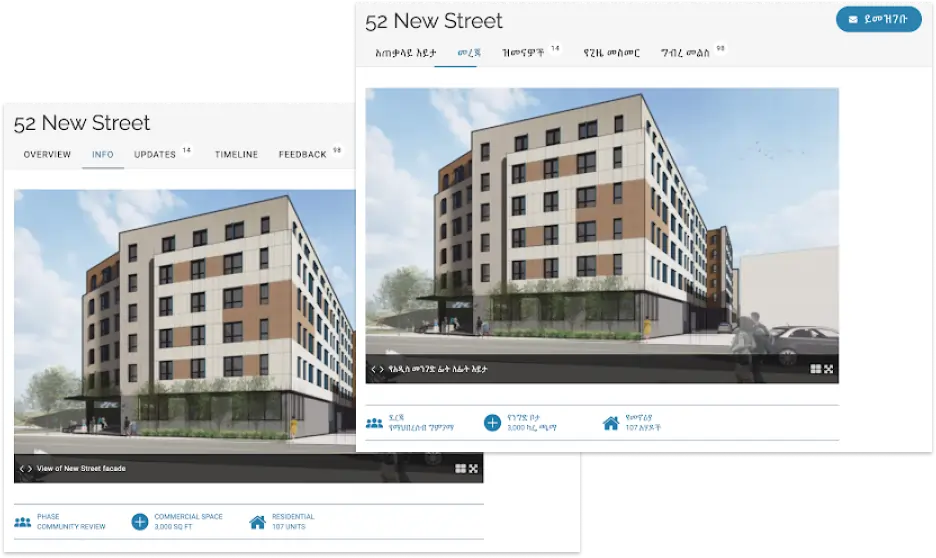
When coUrbanize came to Localize they had two specific challenges. First, they needed a platform where the specific needs for each city project plan could easily be met. Next, the diverse language requirements needed to be quickly translated because community members and project teams are communicating in real time. The solution coUrbanize created was the Language Equity Plan (LEP) to ensure that people whose primary language was not English could have a say in what was built in their neighborhoods.
行业
Community Engagement Software
地区
Cambridge, Massachusetts
与专家交流
阅读时间:2分钟
About coUrbanize
Empower more people where they live and work to share their feedback on community projects

Kristen Veit, Director of Community Engagement Strategy at coUrbanize, wanted to empower more people where they live and work to share their feedback on community projects. “When our customers listen to community members and incorporate their feedback, it’s a win-win: better projects get built and there is higher local support.“ said Kristen. "Our customers, real estate developers and city planners, post frequent updates and community members post comments daily. Therefore, we needed a solution that would allow translations to happen in real time." - Kristen Veit, Dir. of Community Engagement Strategy

问题
They needed a platform where the specific needs for each city project plan could easily be met

"Our customers, real estate developers and city planners, post frequent updates and community members post comments daily. Therefore, we needed a solution that would allow translations to happen in real time." - Kristen Veit, Dir. of Community Engagement Strategy

When coUrbanize came to Localize they had two specific challenges. First, they needed a platform where the specific needs for each city project plan could easily be met. Next, the diverse language requirements needed to be quickly translated because community members and project teams are communicating in real time. The solution coUrbanize created was the Language Equity Plan (LEP) to ensure that people whose primary language was not English could have a say in what was built in their neighborhoods.

他们确定,如果某种第二语言在特定社区的使用率达到或超过5%,那么coUrbanize上的项目就会被翻译成相应的语言。这使得更多人能够参与到平台上来,而无需面对语言障碍这一常见的阻碍。

挑战
如果某个社区中某种第二语言的使用率达到或超过 5%,则coUrbanize上的项目将被翻译成相应的语言。
目标
可扩展的解决方案
Localize 解决方案
Translation is now standard across all coUrbanize projects for languages that meet the threshold of their Language Equity Plan

The newly launched Language Equity Plan (LEP) ensured that community minorities can have a say in what gets built in their neighborhoods. “Localize is a scalable solution that allows us to offer the right translations for all of our customers. We're the only community engagement platform that is currently offering this,” said Kristen.

Translation is now standard across all coUrbanize projects for languages that meet the threshold of their Language Equity Plan. The combination of quality AI translations as their foundation with an option to utilize human translators to proofread these translations was a core reason coUrbanize chose to work with Localize.

随着业务的增长,他们越来越多地使用Localize为coUrbanize上的所有项目提供高质量的翻译。

"One of the most important features we were looking for was the ability to automatically approve and translate all the content on our project websites."
Kristen Veit, Dir. of Community Engagement Strategy
结果
coUrbanize已成功启动32个社区项目,使用25种不同的语言,以覆盖每个社区内的各种母语。

So far, coUrbanize has successfully launched 32 community projects using 25 unique languages to reach the various native languages within each community. “We’ve been able to fully roll out our Language Equity Plan. We can now offer translations to even our smallest municipal and affordable housing customers. We’re excited to take this big step toward a more equitable and inclusive community engagement process.” There has been a remarkable response to the Language Equity Plan initiative. To date, coUrbanize has created over 600,000 translations to get the word out, and it’s working.

"The set-it-and-forget-it approach was a huge time saver and also allowed Localize to be a scalable solution. By simply implementing the Localize code with automatic translations, we’re able to use it across all of our projects."
Kristen Veit, Dir. of Community Engagement
问答

常见问题解答

了解更多关于我们本地化工具的信息。

Localize是如何帮助Code.org缩短本地化周期的?

Localize帮助 Code.org 将 AI 翻译、有针对性的人工审核、上下文编辑、词汇表支持和实时发布整合到一个本地化工作流程中。

Localize如何保证学生和教师所依赖的内容的翻译准确性?

所有译文在发布前都会经过人工审核。审核人员会在实际页面中查看译文的上下文,因此他们能够像发现语气不当的句子一样轻松地发现翻译错误的编码术语。共享的词汇表确保了“循环”和“函数”等词语在 Code.org 支持的所有 29 种语言中保持一致。

Code.org 通过Localize取得了哪些成果?

Code.org 将本地化周期缩短了 50% 以上,消除了发布延迟,并提高了数千个课程的跨语言一致性。

Localize如何支持持续的本地化维护?

Localize帮助团队持续检测、翻译、审核和发布多语言更新,以便翻译后的内容能够随着源内容的变化而保持最新状态。

人工审核仍然是工作流程的一部分吗?

是的。Code.org 使用 AI 翻译以提高速度,并由人工进行审核,以确保翻译质量、术语、语气和文化相关性等关键要素得到充分体现。

准备好让多语言内容更快地流动了吗?

与本地化专家讨论您的目标、当前工作流程以及团队的最佳前进方向。
DeutschEnglishEspañolFrançais日本語Português (Brasil)
Powered by Localize
反馈提交反馈
中文(简体)